Field Notes · Vol. 08 · Conservation & Land Stewardship · 5–6 min read · September 2026
Conservation Programs That Can Help Pay for Land Improvements
Letter 08 · By ACRES KEPT
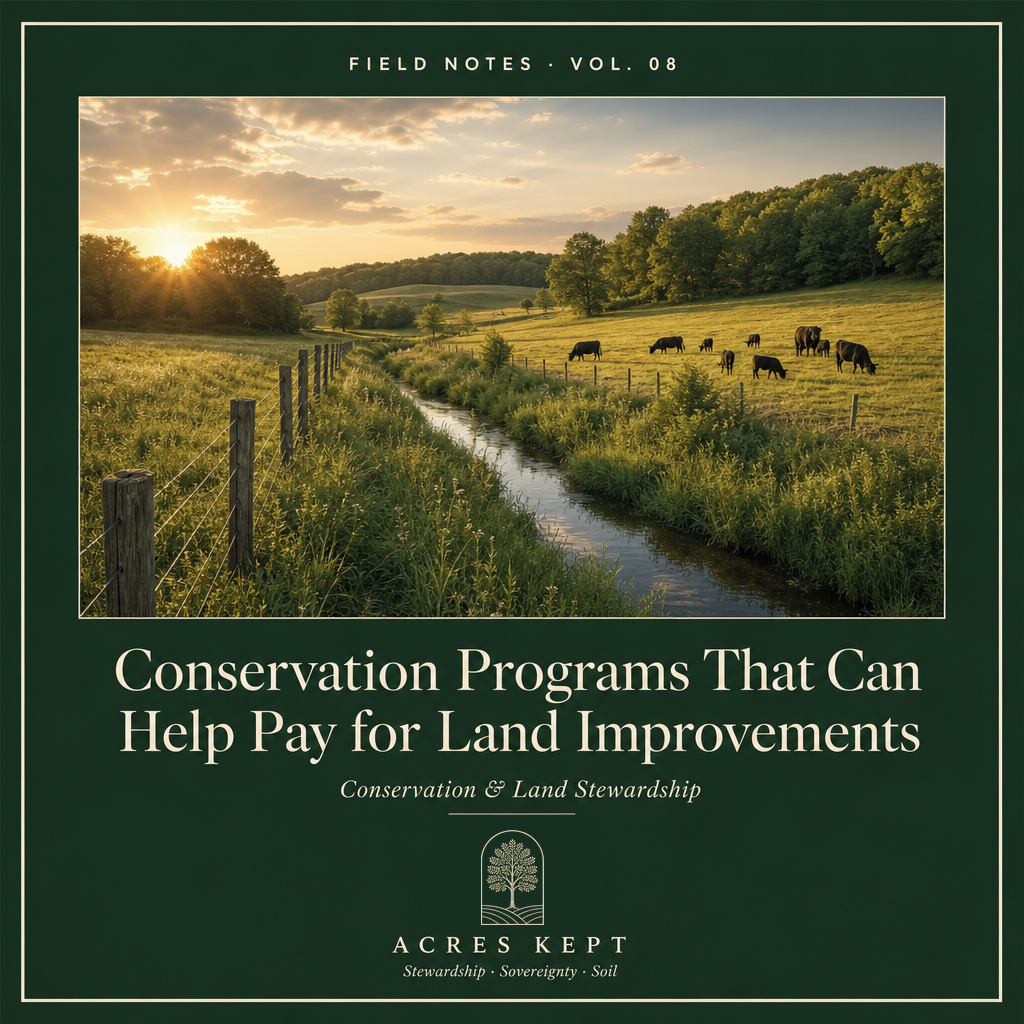
Owning land means taking responsibility for things that are easy to see—and many that are not.
A washed-out area may need erosion control.
A pasture may need better fencing or water access.
A forest may need management.
A streambank may need protection.
A field may benefit from practices that improve soil health or conserve water.
The challenge is that improving land can cost money long before those improvements create an economic return.
That is where conservation programs can matter.
The U.S. Department of Agriculture offers technical and financial assistance that may help eligible farmers, ranchers, forest landowners, and other agricultural producers address natural-resource concerns on their land.
But these programs are often misunderstood.
They are not simply grants for anyone who owns acreage. They do not mean the government pays for every improvement a landowner wants to make. And they should not be treated as a substitute for understanding what the property actually needs.
A better way to think about them is this:
Conservation assistance can sometimes help a landowner share the cost of doing work that strengthens the land over time.
Start with the problem, not the program
It can be tempting to hear about a USDA program and immediately ask:
How much money is available?
A better first question is:
What problem on the land are we trying to solve?
The Natural Resources Conservation Service, or NRCS, approaches conservation this way.
Through the Environmental Quality Incentives Program, commonly called EQIP, NRCS provides technical and financial assistance to eligible agricultural producers and non-industrial private forest landowners. The program is designed to address concerns such as soil erosion, water quality, water conservation, soil health, wildlife habitat, and weather-related risk.
NRCS begins with planning.
A conservation planner may visit the property, talk with the producer or landowner about goals, identify resource concerns, and help determine which conservation practices may be appropriate.
That sequence matters.
The program should follow the land’s needs.
The land should not be reshaped simply because a particular program happens to be available.
1. EQIP: helping address specific land problems
EQIP is one of USDA’s best-known working-lands conservation programs.
Depending on eligibility, location, and the resource concern being addressed, assistance may support practices related to erosion, water management, soil health, habitat, grazing systems, forestry, and other conservation needs.
NRCS describes EQIP as its flagship program for integrating conservation into working agricultural and forest lands. Applications are accepted throughout the year, although states establish ranking dates for particular funding cycles.
That last point is important.
Applying does not automatically mean receiving funding.
Applications are evaluated and ranked, and approved practices are generally tied to a conservation plan and contract.
For a family landowner, the value of EQIP may therefore be twofold:
There may be financial assistance.
But there is also access to technical knowledge about the property.
That technical assistance can be valuable even before a family decides whether a particular project is financially practical.
2. CSP: supporting ongoing stewardship
Some properties have already begun conservation work and may be ready to go further.
The Conservation Stewardship Program, or CSP, is designed for producers who are already managing conservation on working lands and want to maintain and expand those efforts.
NRCS describes CSP as a program that can help participants strengthen conservation across an agricultural operation. Contracts generally run for five years, and payments can reflect both maintaining existing conservation and adopting additional conservation activities.
That distinction matters.
Conservation is not always a one-time project.
Improving soil, managing grazing, protecting water, enhancing habitat, or building a more resilient farming system may require changes in how the property is managed year after year.
For families thinking long term, CSP reinforces an important idea:
Stewardship is not just improving the land once. It is developing a way of managing it.
3. CRP: when conservation may be the better use
Sometimes the most responsible use of an acre is not production.
The Conservation Reserve Program, administered through USDA’s Farm Service Agency, provides another model.
Under General CRP, environmentally sensitive agricultural land may be placed under a conservation contract rather than being actively farmed or ranched. Participants may receive annual rental payments and cost-share assistance while establishing approved conservation cover such as grasses or trees. Contracts generally run from 10 to 15 years.
USDA reported accepting approximately 2.2 million acres into CRP through 2026 enrollment activity.
CRP illustrates the point we discussed in an earlier Field Note:
Not every acre needs to be farmed in order to contribute value.
On the right property, conservation may help reduce erosion, improve water quality, support wildlife, and provide an economic return through program payments.
But a 10- or 15-year agreement is significant.
Families should understand what they are committing to and how that commitment fits future plans for the property.
Conservation can help with the cost of keeping land
For many families, the biggest obstacle is not deciding that land should be cared for.
It is paying for the work.
Fencing, water systems, erosion control, forestry improvements, habitat practices, soil-health measures, and other projects can require meaningful investment.
USDA financial assistance may help eligible participants cover part of the cost of approved practices.
NRCS also provides technical assistance without charge, including resource assessment, conservation planning, practice design, and monitoring guidance.
That does not make conservation free.
Programs may involve eligibility requirements, documentation, contracts, implementation standards, deadlines, and ongoing responsibilities.
But when the work aligns with both the property’s needs and the family’s goals, conservation assistance can change what is financially possible.
Ownership and records still matter
Families should also recognize that applying for agricultural programs often requires more than simply showing that the land exists.
For EQIP, NRCS states that applicants generally need farm records established or updated with the Farm Service Agency for both the applicant and the land.
That connects directly to earlier Field Notes about deeds, estate records, ownership interests, and family readiness.
A conservation opportunity can expose an ownership problem that has been ignored for years.
Who has authority to enroll the property?
Whose name is associated with the farm record?
Can the family enter a multi-year agreement?
These are not reasons to avoid conservation programs.
They are reminders that land stewardship and ownership readiness are connected.
Not every program is right for every property
The existence of financial assistance should never be the sole reason to undertake a conservation practice.
A landowner should understand:
What problem is being addressed?
What will the practice change?
What responsibility remains after installation?
How long does the agreement last?
What portion of the cost does the family carry?
And does the practice support the family’s longer-term vision for the property?
The right answer will differ from one property to another.
The ACRES KEPT perspective
Conservation should not be viewed only as an environmental obligation.
For family landowners, it can also be part of protecting the usefulness, resilience, and long-term economic value of the property.
A healthier soil system may support future production.
Better water management may reduce damage.
Managed forestland may become more productive.
Protected acreage may serve a purpose that cultivation never could.
And financial or technical assistance may help make some of those improvements possible.
But the program should never become the plan.
The land and the family’s goals come first.
Then the question becomes:
Which resources can help us carry out that stewardship responsibly?
Sometimes the answer may include EQIP.
Sometimes CSP.
Sometimes CRP.
Sometimes another state, local, or private conservation resource.
And sometimes the right answer is simply to understand the property better before applying for anything.
Good stewardship is not about chasing programs.
It is about knowing what the land needs—and recognizing when the right program can help you do something about it.
Sources Referenced
- USDA Natural Resources Conservation Service — Environmental Quality Incentives Program (EQIP)
- USDA Natural Resources Conservation Service — Conservation Stewardship Program (CSP)
- USDA Farm Service Agency — Conservation Reserve Program (CRP)
- USDA Service Centers — conservation planning, technical assistance, eligibility, and program application resources
Field Notes provides general educational information and does not constitute legal, tax, financial, investment, agricultural, forestry, conservation, environmental, or real estate advice. Program eligibility, ranking dates, available practices, payment rates, and funding vary by program, state, year, and individual circumstances. Landowners should verify current information with USDA or another qualified professional.