Field Notes · Vol. 05 · Land Use & Stewardship · 5–6 min read · August 2026
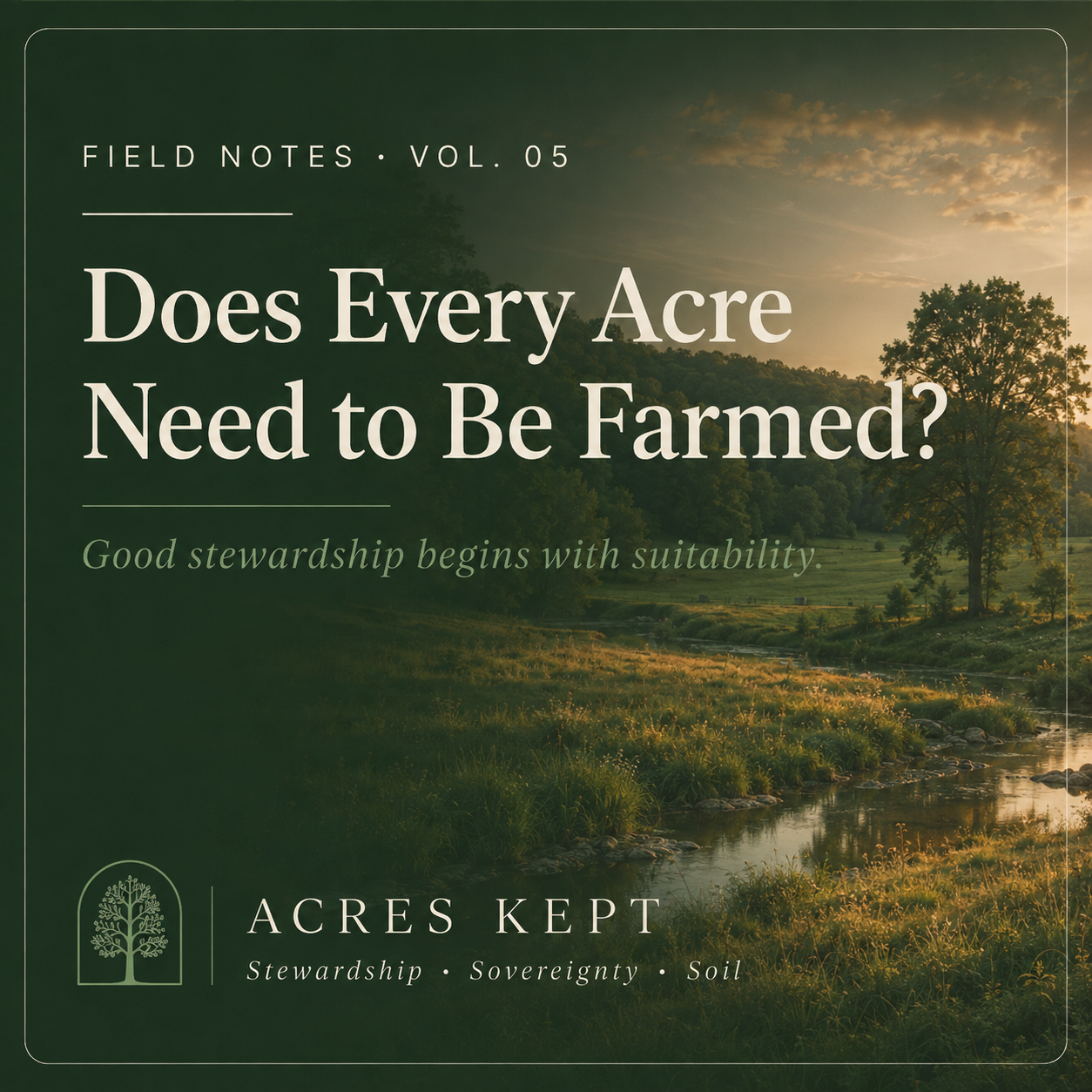
Does Every Acre Need to Be Farmed?
Letter 05 · By ACRES KEPT
There is a tendency to look at rural land and ask one immediate question:
What can we grow here?
It is an understandable question. For generations, productive land has often been associated with fields, crops, livestock, and visible agricultural activity.
But good stewardship begins with a different question:
What is this land actually suited to do?
Not every acre should be cultivated. Not every wooded acre should be cleared. Not every wet area should be drained. And not every piece of family land needs to produce income in exactly the same way.
The strongest land-use decisions begin by understanding the property itself — its soil, water, slope, timber, access, infrastructure, environmental conditions, and the goals of the people who own it.
Sometimes the most productive decision is knowing what not to force the land to become.
Productive does not always mean cultivated
A 100-acre family property may contain several very different kinds of land.
Twenty acres may have productive soils and good access for crops.
Forty acres may be established timber.
Ten acres may remain wet much of the year.
Another section may be better suited to grazing, wildlife habitat, a conservation practice, or simply remaining undisturbed.
Calling all 100 acres “farmland” does not mean all 100 acres should be managed the same way.
USDA’s Natural Resources Conservation Service evaluates agricultural land using factors including soil characteristics, land capability, productivity, and site conditions. Its Land Evaluation and Site Assessment system reflects an important principle: agricultural suitability is something to be evaluated, not assumed.
Soil is part of that calculation, but it is not the only consideration.
Water availability matters. Drainage matters. Slope matters. Access matters. The cost of bringing equipment onto the property matters. What has happened on surrounding land matters.
The question is not simply whether something can be grown.
It is whether growing it makes sense on that particular acre.
Investors already think this way
There is something family landowners can learn from the way sophisticated farmland buyers evaluate property — even when the family has no intention of selling.
AcreTrader, for example, describes farmland due diligence as an examination of factors such as soil type and productivity, water availability, irrigation infrastructure, historical yields, rents, regional commodity conditions, and local land-market activity.
Its educational materials also distinguish between total acreage and tillable acreage — the portion of a farm that can actually be used for crop production. AcreTrader notes that a property with substantial acreage that cannot be cultivated may produce very different economics from one where most acres are tillable.
That perspective is useful beyond investment.
Families should know that an acre can have value even if it is not a crop acre. But they should also understand that different acres create different kinds of value.
Some generate annual farm income.
Some produce timber over a longer cycle.
Some provide grazing.
Some protect water.
Some reduce erosion.
Some support wildlife.
Some may qualify for conservation programs.
And some simply help protect the long-term integrity of the property.
Forestry can be productive land use
In much of the South, family land and forestland are closely connected.
A wooded tract may sometimes be described casually as land that is “not being used.” Yet responsibly managed forestland can be both economically productive and ecologically valuable.
Timber can provide periodic income rather than annual crop revenue. Forests may also provide wildlife habitat, erosion control, recreational use, shade, water protection, and a legacy asset that grows over time.
The question should not be:
How quickly can we clear this acreage?
It should be:
What role should these trees play in the long-term plan for the property?
That may eventually require a consulting forester or other qualified forestry professional to evaluate timber condition, management needs, marketability, and long-term objectives.
Clearing land simply to make it look productive can destroy something that was already producing value.
Wet land is not automatically wasted land
Wetlands, flood-prone areas, streams, ponds, and poorly drained soils require the same kind of restraint.
Trying to make every acre behave like upland cropland can create enormous expense and, in some circumstances, regulatory or environmental problems.
Water is increasingly an important factor in farmland evaluation. AcreTrader specifically considers water resources when assessing agricultural property, reflecting the reality that productive land is not simply about acreage — it is also about whether adequate and dependable water exists for the intended use.
Yet water can be an asset even when it limits cultivation.
Wet areas may protect downstream property, provide wildlife habitat, support timber species adapted to those conditions, or contribute to conservation objectives.
Stewardship means understanding those functions before deciding that the land needs to be changed.
Sometimes the answer is grazing, leasing, or conservation
A family does not have to become a full-time farming operation to put land to productive use.
Pasture is itself a recognized agricultural land use. NRCS describes pasture as land managed primarily with forage vegetation for livestock grazing, often involving practices such as mowing, fertilization, weed control, and renovation.
Other properties may be suitable for leasing to an experienced farmer or livestock operator rather than having the family take on production directly.
USDA research shows how significant leasing already is within American agriculture: approximately 39 percent of farmland in the contiguous United States is rented, including more than half of cropland.
That matters because ownership and operation do not have to be the same thing.
A family can retain land while allowing an appropriate operator to use part of it.
Conservation may be another legitimate use. American Farmland Trust’s work centers not only on protecting farmland from development but also on promoting sound farming practices and keeping farmers on the land.
The broader point is that stewardship can include production and protection.
Those goals are not necessarily in conflict.
The most profitable acre is not always the best measure
There is another reason families should avoid forcing every acre into immediate production.
Farm economics change.
USDA currently forecasts that inflation-adjusted net farm income will decline in 2026 from the prior year, even though overall farm-sector income remains above its longer-term average. Performance also varies considerably by region and production specialty.
That means an enterprise that makes sense in one county, on one soil type, with one operator and one set of market conditions may make little sense somewhere else.
Families should be cautious about starting with a popular crop or business idea and then trying to make the property fit it.
Start with the land.
Then consider the enterprise.
That order matters.
Stewardship begins with suitability
Before deciding that land should be cleared, planted, grazed, leased, conserved, or developed, a family should understand what it is working with.
That means asking questions such as:
- Which areas have agricultural potential?
- Which are better suited to timber?
- Where does water move across the property?
- Which acres are difficult or costly to access?
- What infrastructure already exists?
- What uses fit the family’s goals and capacity?
- What parts of the land may be more valuable left largely as they are?
Those questions do not produce a single definition of productive land.
They produce something better:
a land-use strategy grounded in the actual property.
The ACRES KEPT perspective
A family should not feel pressure to make every acre look productive in order for the land to have value.
Good stewardship is not measured by how much land is cleared or how many acres are planted.
It is measured by whether decisions respect the land’s capabilities, the family’s goals, and the responsibility of carrying that asset forward.
One property may support crops, timber, grazing, conservation, recreation, and family use at the same time.
Another may be best served by doing much less.
The objective is not maximum activity.
It is appropriate use.
Before asking what you can make the land produce, ask what the land is prepared to support.
That distinction can protect both the property and the family investing in its future.
Sources Referenced
- U.S. Department of Agriculture, Natural Resources Conservation Service — Land Evaluation and Site Assessment, land-use and pasture resources
- U.S. Department of Agriculture, Economic Research Service — farmland ownership and tenure, land values, and 2026 farm-income outlook
- AcreTrader Learning Center — farmland due diligence, tillable acreage, soil, water, and agricultural-property evaluation
- American Farmland Trust — farmland protection and sound land-management practices
Field Notes provides general educational information and does not constitute legal, tax, financial, investment, agricultural, forestry, conservation, environmental, or real estate advice. Land conditions and regulations vary. Landowners should consult qualified professionals regarding their individual property and objectives.
Working Through This for Your Family?
Understanding the issue is one step. ACRES KEPT members have access to tools, guidance, intelligence and trusted resources to help work through what it may mean for their own land.
See What Landowner Membership Includes →