Field Notes · Vol. 07 · Land Evaluation & Steward Readiness · 5–6 min read · September 2026
How to Evaluate Acreage Before You Fall in Love With It
Letter 07 · By ACRES KEPT
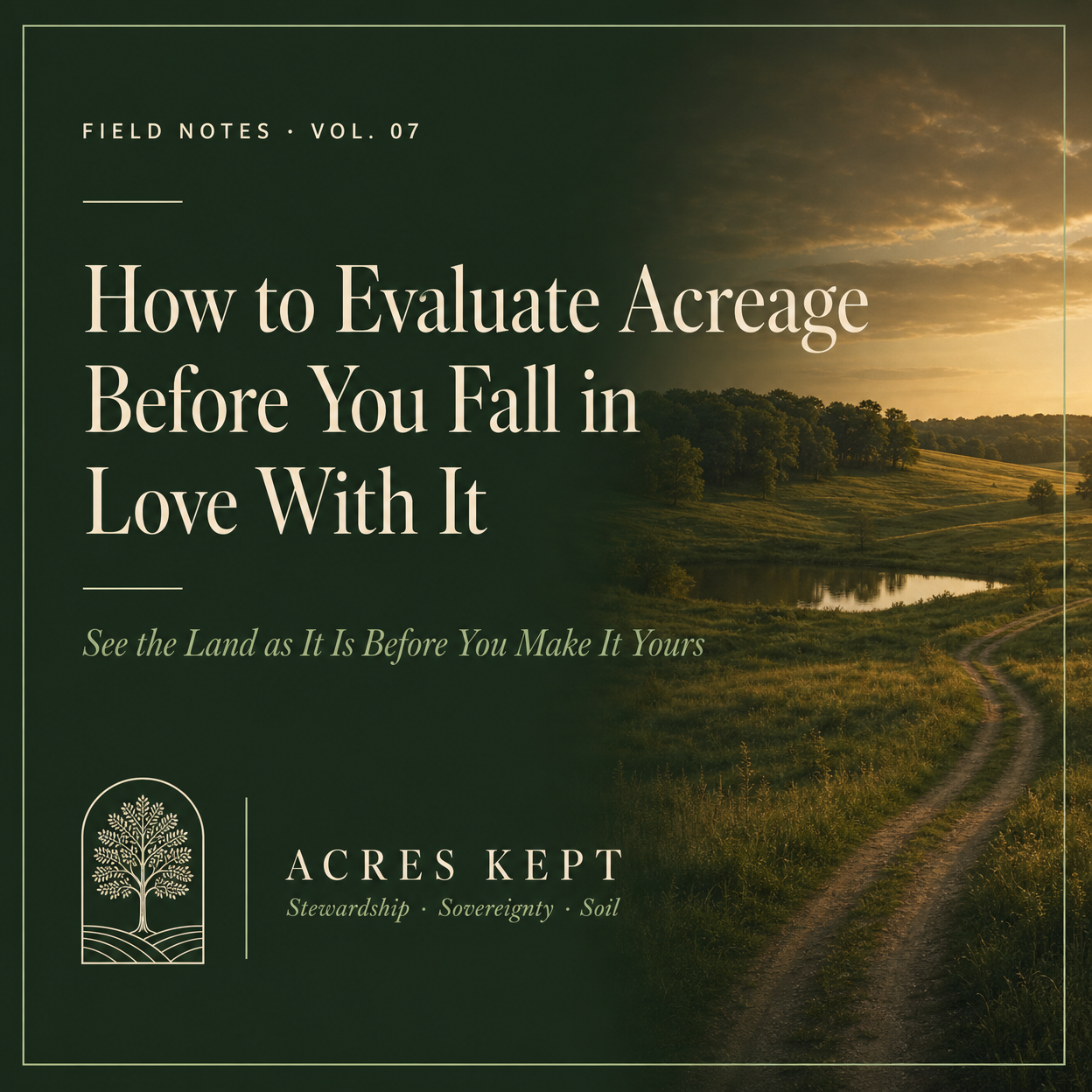
There is something powerful about standing on a piece of land and imagining what it could become.
A field becomes a farm.
A wooded tract becomes a place to build.
A pond becomes the center of an agritourism idea.
A few open acres become crops, livestock, cabins, events, or a future business.
That vision matters. It is often what moves someone from simply wanting land to becoming serious about stewardship.
But vision can also cause us to stop asking questions too soon.
Before falling in love with acreage, there is a more important question:
What is this land actually capable of supporting?
The answer rarely comes from acreage alone.
A 50-acre property can be very different from another 50-acre property. Soil, water, drainage, slope, access, timber, flood risk, infrastructure, easements, surrounding land use, and the property’s history can all shape what is realistically possible.
Good stewardship begins by learning to see the land as it is—not only as we hope it might become.
1. Start with the soil
Soil is one of the most important characteristics of agricultural land, but it is also one of the easiest things to overlook when a property looks beautiful.
The U.S. Department of Agriculture’s Natural Resources Conservation Service maintains the Web Soil Survey, which gives landowners, producers, and others access to official soil data used for land-use and management decisions. NRCS notes that soils can differ significantly even within the same property. Some may be seasonally wet, prone to flooding, shallow, poorly drained, or otherwise limited for certain uses.
That means “good-looking land” is not necessarily good cropland.
NRCS also evaluates agricultural land according to suitability for specific uses. Its Land Evaluation and Site Assessment system considers soil capability and productivity alongside non-soil factors and local conditions.
For a prospective steward, soil information does not make the decision.
It tells you which questions deserve more attention.
2. Follow the water
Water can be an asset, a limitation, or both.
A creek may look attractive. A pond may add recreational or agricultural value. Wet areas may support habitat or timber. But water also raises questions about drainage, flooding, irrigation, erosion, access, and what portions of the property can reasonably support structures or production.
AcreTrader’s farmland due-diligence process considers water access alongside soil quality, climate, drainage, crop history, and other property characteristics. Its research reflects a principle that applies far beyond institutional investing: the usefulness of agricultural land depends partly on whether the property has the right water conditions for the intended use.
Too little water can constrain production.
Too much water in the wrong place can do the same.
Before imagining what will be planted, built, or grazed, understand how water behaves across the property.
3. Look beyond the acreage number
A listing may advertise 40 acres, 75 acres, or 100 acres.
But the total acreage tells only part of the story.
How much is open?
How much is wooded?
How much is wet?
How much is accessible?
How much is suitable for the use you are considering?
AcreTrader’s due-diligence process examines factors such as drainage, elevation, soil quality, historic imagery, crop history, county yields, rental conditions, and surrounding markets rather than treating acreage as a sufficient measure of value.
The same discipline is useful for an individual steward.
Ten highly usable acres with good access, soil, and infrastructure may fit a particular plan better than 50 difficult acres that require substantial clearing, drainage, roadwork, or utilities.
More acreage is not automatically more opportunity.
4. Ask how you will reach and use it
Land access is easy to underestimate.
A property may have road frontage but no practical entrance for equipment. A wooded tract may have internal roads that become impassable after heavy rain. A field may be separated from the road by a drainage area. A parcel may depend on an easement across someone else’s property.
Infrastructure matters, too.
Water, electricity, fencing, barns, storage, gates, wells, septic capacity, broadband, and road improvements can significantly affect the cost of turning an idea into an operating reality.
AcreTrader includes site visits and local review in its screening process because maps and datasets cannot reveal everything about a property. Its process may include checking drainage, water conditions, soils, crop health, and other on-the-ground characteristics.
Prospective stewards should take the same lesson seriously.
A property should be walked, observed, and questioned—not simply admired from a listing photo.
5. Understand what surrounds the land
Acreage does not exist in isolation.
The neighboring property matters.
So does the road.
So does nearby development.
A quiet rural tract today may sit near an expanding subdivision, industrial project, utility corridor, solar development, or commercial area tomorrow.
Other surroundings may be beneficial: nearby farms, forestry operations, equipment dealers, processors, markets, Extension support, or established agricultural infrastructure.
NRCS’s land-evaluation approach expressly considers non-soil factors and development pressure when assessing land-use decisions.
That is a reminder to look beyond the property line.
Ask not only what the parcel is today, but what may be changing around it.
A beautiful property can still be the wrong property
There is nothing wrong with being inspired by land.
The problem comes when inspiration becomes the evidence.
A beautiful tree line does not tell you whether the title is clear.
A green field does not tell you what the soil can support.
A pond does not tell you whether water is dependable.
A long driveway does not tell you whether equipment can reach the back acreage.
And an attractive price does not tell you what it will cost to make the property usable.
This is why due diligence matters.
AcreTrader reports that only a small portion of properties it researches ultimately move through its full investment process, reflecting how many variables must align before land fits a specific purpose.
A family or individual buying 10 acres does not need an institutional investment committee.
But they do need the same basic discipline:
Understand the land before committing to the vision.
The ACRES KEPT perspective
Prospective stewards sometimes begin with the dream:
“I want a farm.”
“I want 50 acres.”
“I want land with trees and water.”
Those are starting points.
They are not yet land criteria.
A better process begins by asking what you intend to do, what the property must support for that plan to work, and which characteristics would make the land unsuitable.
Soil matters.
Water matters.
Access matters.
Infrastructure matters.
Surrounding land use matters.
And perhaps most importantly, the relationship between all of those things matters.
The right property is not simply the one that inspires you.
It is the one whose capabilities, limitations, costs, and possibilities fit the stewardship responsibility you are prepared to take on.
Fall in love with the vision if you must.
But evaluate the land before you make it yours.
Sources Referenced
- USDA Natural Resources Conservation Service — Web Soil Survey and Land Evaluation and Site Assessment
- AcreTrader Learning Center — farmland due diligence, soil, drainage, water, valuation, and site evaluation
Field Notes provides general educational information and does not constitute legal, tax, financial, investment, agricultural, environmental, surveying, engineering, or real estate advice. Prospective landowners and stewards should consult qualified professionals regarding individual properties and intended uses.