Field Notes · Vol. 14 · Land, Community & Stewardship · 5–6 min read · October 2026
What Can a Rural Community Tell You About the Land?
Letter 14 · By ACRES KEPT
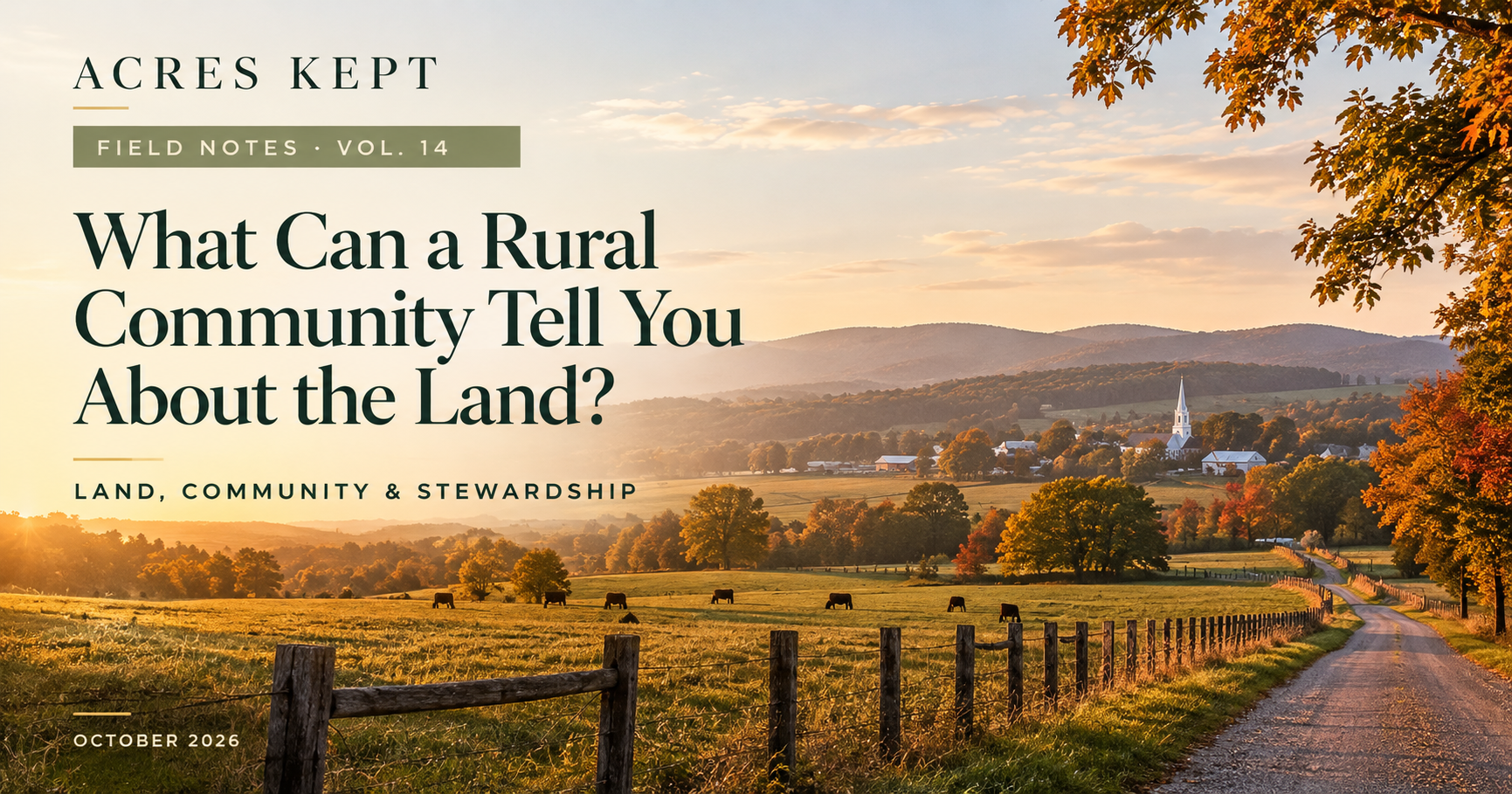
When we evaluate land, we tend to begin at the property line.
How many acres?
What kind of soil?
Is there water?
What is wooded?
What is open?
What can be farmed, grazed, leased, conserved, or developed?
Those questions matter.
But land does not exist by itself.
It sits inside a community.
And sometimes the community surrounding a property tells us almost as much about its future as the acreage does.
Who farms nearby?
What industries support the local economy?
Are there processors, equipment dealers, foresters, livestock producers, Extension agents, contractors, or markets within reach?
Are younger families staying?
Are older landowners preparing for transition?
Is development moving toward the area—or away from it?
Before deciding what land should become, it is worth understanding the place around it.
A parcel is part of a larger working landscape
A 100-acre property can look very different depending on where it sits.
In one county, those acres may be surrounded by row crops and supported by grain elevators, farm suppliers, equipment dealers, and experienced operators.
In another, forestry may dominate.
Elsewhere, cattle, poultry, specialty crops, recreation, or conservation may be more closely connected to the local economy.
Those surrounding systems affect what is practical.
They influence who might lease land.
Who can manage timber.
Where crops can be sold.
Whether equipment and labor are available.
And whether a prospective steward can realistically build the enterprise imagined for the property.
This is one reason ACRES KEPT encourages families and prospective stewards to evaluate more than acreage.
Land capability matters.
But so does the ecosystem around the land.
Catahoula Parish offers a useful example
Next week, ACRES KEPT will be in Sicily Island, Louisiana, in Catahoula Parish.
It is a useful place from which to think about the relationship between land and community.
According to USDA’s 2022 Census of Agriculture, Catahoula Parish had 427 farms covering approximately 289,000 acres—an average of 677 acres per farm.
About 205,000 acres were classified as cropland, with another roughly 44,700 acres in woodland.
Crop production accounted for approximately 97 percent of agricultural sales reported in the parish.
The LSU AgCenter describes Catahoula as a major agricultural parish producing crops including corn, cotton, soybeans, wheat, grain sorghum, and rice, while also supporting livestock, forestry, wildlife, and other natural-resource enterprises.
Those numbers tell us something.
But they do not tell us everything.
Statistics describe the land. Communities explain how it works.
USDA data can tell us how many acres are farmed.
It can tell us acreage, farm size, sales, irrigation, and land use.
What it cannot fully tell us is how a place functions from one season to another.
Who is renting whose fields?
Which families have held land for generations?
Who is looking for acreage?
Which local operator has the equipment to manage another 200 acres?
Who knows where the water stands after a heavy rain?
Which timber tract has been managed—and which one has simply been left alone?
Which landowners are actively planning for the next generation?
Much of that knowledge lives in communities.
That is why local conversations matter.
Local institutions are part of the stewardship infrastructure
When families think about resources for land, they often think first about money.
But rural communities also contain knowledge infrastructure.
Extension offices are one example.
The LSU AgCenter’s Catahoula Parish office provides local programming in agriculture and natural resources, including producer education, crop and livestock information, forestry education, wildlife management, pesticide training, and on-farm demonstrations.
Those resources matter because landowners rarely need only one kind of expertise.
A family may need help understanding soil.
Then forestry.
Then a lease.
Then an invasive species.
Then a conservation program.
Then succession.
The strongest land decisions are often made by connecting several sources of trusted expertise rather than relying on one person to answer everything.
That is part of the ACRES KEPT philosophy:
Good stewardship includes knowing where reliable help can be found.
Population change matters too
Land decisions do not happen separately from demographic change.
The Census Bureau estimated Catahoula Parish’s 2025 population at approximately 8,223, down from 8,906 in 2020 and 10,407 in 2010. About 23 percent of the current population is age 65 or older.
Those numbers raise questions that matter far beyond one Louisiana parish.
Who will own rural land twenty years from now?
Who will operate it?
Who will inherit it but live somewhere else?
Who wants to farm but does not own land?
Who has land but no successor prepared to manage it?
And what happens when the people who know the property best are no longer the people making the decisions?
That is where land-transition work becomes community work.
A family’s ownership decision may ultimately affect neighboring farms, local tax bases, agricultural businesses, forests, wildlife habitat, and the next generation of land stewards.
The market does not tell you everything about a place
Land value matters.
But price is only one signal.
A property may appreciate while the local agricultural infrastructure around it weakens.
Another community may have modest land prices but a strong network of farmers, foresters, cooperatives, Extension professionals, contractors, and markets.
One place may have significant development pressure.
Another may face population loss.
Another may have abundant land but few people prepared to operate it.
Those conditions influence stewardship possibilities.
For a prospective buyer, understanding the local environment can prevent buying land that fits the dream but not the operating reality.
For an existing family landowner, understanding those conditions may reveal opportunities that were not obvious from inside the property line.
Local knowledge should inform—not replace—due diligence
There is a danger in romanticizing local knowledge.
Knowing someone who has lived in the community for fifty years does not replace a survey.
A neighbor’s memory does not replace a deed.
A handshake does not replace a lease.
And local opinion does not replace soil data, legal advice, title work, financial analysis, or professional forestry and agricultural guidance.
But those formal resources do not replace local knowledge either.
The strongest preparation often uses both.
Data can show where a property is located in a floodplain.
A neighbor may tell you where the water actually stood during the last major storm.
A forestry professional can evaluate timber.
A longtime landowner may know when that stand was last cut.
A deed can establish access rights.
Someone nearby may know whether the road is passable after three days of rain.
Neither source should stand alone.
Community events can be part of learning a place
This is one reason community gatherings matter more than they may appear to.
A fall festival is not a land-use meeting.
But it brings together people who know a place.
Farmers.
Landowners.
Families.
Business owners.
Local leaders.
People who moved away and returned.
People who stayed.
And people thinking about what comes next.
For ACRES KEPT, being present in Sicily Island on October 31 is not simply about introducing a platform.
It is an opportunity to listen.
What are families concerned about?
What kinds of land do they own?
What changes have they seen?
What resources do they trust?
What does keeping land mean in that community?
Those conversations are part of understanding the landscape too.
The ACRES KEPT perspective
Land stewardship is deeply personal.
But it is never completely individual.
Every parcel sits within something larger.
A watershed.
A road system.
An agricultural economy.
A forest.
A tax jurisdiction.
A community.
A network of people with knowledge, history, needs, and opportunity.
That is why understanding land requires more than looking down at a parcel map.
Sometimes we also need to look outward.
What is happening around the property?
Who is still working the land?
What resources exist nearby?
What is changing?
What is disappearing?
And where might the next generation of stewardship come from?
Next week, those are some of the questions ACRES KEPT will carry with us to Sicily Island.
Because understanding a place begins with data.
But understanding what the land may become often begins by listening to the people who live there.
Sources Referenced
- U.S. Department of Agriculture National Agricultural Statistics Service — 2022 Census of Agriculture, Catahoula Parish, Louisiana
- LSU AgCenter — Catahoula Parish Profile; Agriculture and Natural Resources; Forestry and Wildlife
- U.S. Census Bureau — Catahoula Parish population and demographic estimates
Field Notes provides general educational information and does not constitute legal, tax, financial, investment, agricultural, forestry, conservation, environmental, or real estate advice. Landowners and prospective stewards should verify local conditions and consult qualified professionals regarding individual properties and circumstances.