Field Notes · Vol. 10 · Family Land & Ownership Readiness · 5–6 min read · September 2026
When Family Land Has Multiple Owners: What Changes?
Letter 10 · By ACRES KEPT
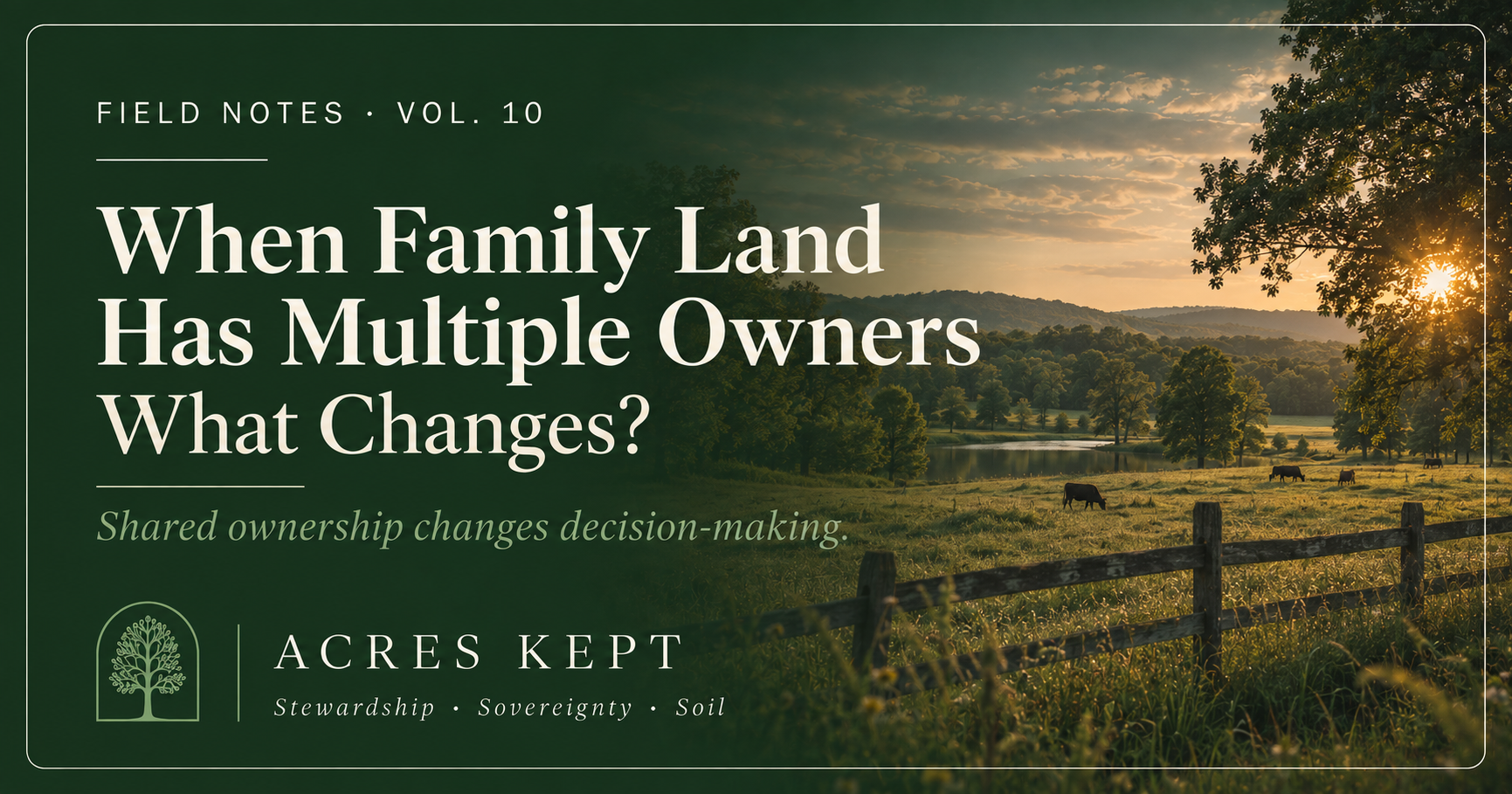
Family land can become complicated without anyone intending for it to.
A parent dies.
Then a sibling.
Then another generation inherits.
Before long, a property that once had one owner may have several.
Sometimes dozens.
The family may still think of it as “our land.”
But legally and practically, shared ownership changes what the family can do with the property.
That matters when the family wants to farm it, lease it, improve it, enroll it in a program, borrow against it, transfer it, or make a long-term plan.
The question is no longer only:
“What do we want to do with the land?”
It may also become:
“Who has the authority to make that decision?”
Shared ownership changes decision-making
When several people own interests in the same property, they may not each own a separate physical piece.
Instead, they may hold undivided interests in the whole.
USDA guidance on heirs’ property explains that descendants may become joint owners with undivided interests, sometimes without clear or marketable title. USDA also notes that management becomes more difficult because heirs may need to agree on important land-use decisions.
That distinction is important.
One family member may live on the land.
Another may pay the taxes.
Another may manage the property.
Another may not have visited in years.
But those facts do not necessarily determine legal ownership.
Ownership follows title, probate, inheritance law, deeds, and other legal records.
That is why families can become surprised by who actually has a legal interest in the property.
More owners can mean more complexity
Shared ownership is not automatically a problem.
Families can and do manage jointly owned land successfully.
The challenge is that the number of owners can grow over time.
The Federation of Southern Cooperatives describes heirs’ property as land inherited by multiple family members, often because ownership passed without a will or because property was left jointly to several heirs. The organization has spent decades helping families across the South address title, mediation, and land-retention issues.
With each generation, the ownership group may expand.
One owner’s interest may pass to several children.
Those interests may later pass again.
Eventually, a property may involve relatives who live in different states, have different financial circumstances, and hold very different ideas about the land.
One person may want to farm.
Another may want income.
Another may want to sell.
Another may want the land preserved.
Another may not know enough about the property to have formed an opinion at all.
Those differences become important when the family needs to act.
A family representative is not automatically the legal decision-maker
Many families have one person who manages everything.
That person may pay the property taxes, coordinate maintenance, speak with neighbors, arrange timber work, or communicate with agencies.
That role can be extremely valuable.
But being the person who takes care of the land does not automatically mean that person has the legal authority to make decisions for every owner.
That becomes especially important with consequential agreements.
A lease.
A sale.
A conservation agreement.
A loan.
An easement.
A timber contract.
A development arrangement.
Before signing something that affects the property, the family should understand who must legally consent.
The answer will depend on the ownership structure, state law, the type of transaction, and the specific facts surrounding the property.
This is one reason ACRES KEPT consistently returns to the same principle:
Know who owns the land before deciding what to do with it.
Clear title affects more than a future sale
Families sometimes think title issues matter only when someone wants to sell.
They can affect much more than that.
USDA notes that heirs’ property owners may have difficulty demonstrating clear ownership when seeking access to certain agricultural programs and benefits. Federal law has created pathways that can help some heirs’ property operators establish farm records for USDA purposes, but unresolved ownership can still complicate land management.
Clear ownership can also matter when trying to:
- lease property,
- complete improvements,
- enter a long-term contract,
- obtain financing,
- settle an estate,
- transfer interests,
- or establish a future ownership structure.
The Center for Heirs’ Property Preservation works with families on probate, deed consolidation, and other legal processes intended to clarify ownership and simplify family land arrangements.
In other words, ownership readiness is not simply paperwork.
It affects what the land can practically do.
Shared ownership can expose the land to outside pressure
Perhaps the most difficult part of shared ownership is that every owner may not share the same goals.
In some heirs’ property situations, an individual owner may transfer his or her interest to someone outside the family.
That outside party can then become a co-owner.
The American Bar Association has documented how heirs’ property can become vulnerable to partition actions and involuntary sales, particularly when outside purchasers acquire an ownership interest.
The Federation of Southern Cooperatives has documented families facing exactly this situation: one or more relatives sold an interest, and the remaining family later faced legal pressure involving the entire property.
Laws in many states have changed to provide additional protections for qualifying heirs’ property.
But those protections do not eliminate the importance of preparation.
Families should understand how ownership is structured before a disagreement or outside offer creates urgency.
The family conversation should happen before the transaction
Shared ownership is partly a legal issue.
It is also a communication issue.
Families often delay difficult conversations because no immediate decision is required.
But waiting until someone wants to sell, lease, develop, harvest timber, or divide the property can make those conversations much harder.
A more useful family discussion may begin with basic questions:
- Who currently owns an interest?
- Who is using the land?
- Who is paying expenses?
- What does each owner want the property to provide?
- Does anyone want to sell his or her interest?
- Does the family want to keep the property together?
- Who is prepared to manage it?
- What happens when the next generation inherits?
Those questions do not resolve title.
They help the family understand whether everyone is working from the same assumptions.
Shared ownership does not have to mean permanent confusion
Families may have options for simplifying ownership.
Depending on the circumstances, those options can include probate, deed consolidation, transfers among relatives, estate planning, trusts, LLCs, buyouts among co-owners, or other legal structures.
The Center for Heirs’ Property Preservation, for example, assists families with deed consolidation when several relatives own property together and some heirs prefer to transfer their interests to family members who want to retain the land.
The American Bar Association likewise notes that families may address heirs’ property through estate planning, transfers, buyouts, or shared ownership structures such as an LLC, depending on their objectives and legal circumstances.
None of those approaches is universally right.
The goal is not to force every family into the same ownership model.
It is to make the ownership structure intentional rather than accidental.
The ACRES KEPT perspective
Family land often becomes shared land because families grow.
That is not unusual.
But as the number of owners grows, assumptions become more dangerous.
One person cannot assume everyone wants the same thing.
The family cannot assume the person maintaining the property owns all of it.
And no one should assume that an informal understanding among relatives will always be enough.
Before deciding whether to sell, lease, conserve, farm, develop, or transfer family land, understand the ownership first.
Who owns it?
How did they acquire their interests?
Who has authority to act?
What does the family want the property to become?
And is the current ownership structure helping the family accomplish that?
Shared ownership does not automatically make land unmanageable.
But unmanaged ownership can make almost every future decision harder.
The family decides.
ACRES KEPT helps the family prepare for that decision.
Sources Referenced
- U.S. Department of Agriculture Farm Service Agency — heirs’ property and complex land ownership guidance
- Federation of Southern Cooperatives/Land Assistance Fund — heirs’ property, land retention, mediation, and technical assistance
- Center for Heirs’ Property Preservation — probate, deed consolidation, and family land legal services
- American Bar Association — heirs’ property, partition law, and the Uniform Partition of Heirs Property Act
Field Notes provides general educational information and does not constitute legal, tax, financial, investment, agricultural, estate-planning, or real estate advice. Ownership rights, probate requirements, partition laws, and heirs’ property protections vary by state and individual circumstances. Families should consult qualified legal and other professional advisers regarding their specific property.