Field Notes · Vol. 13 · Family Land & Stewardship Readiness · 5–6 min read · October 2026
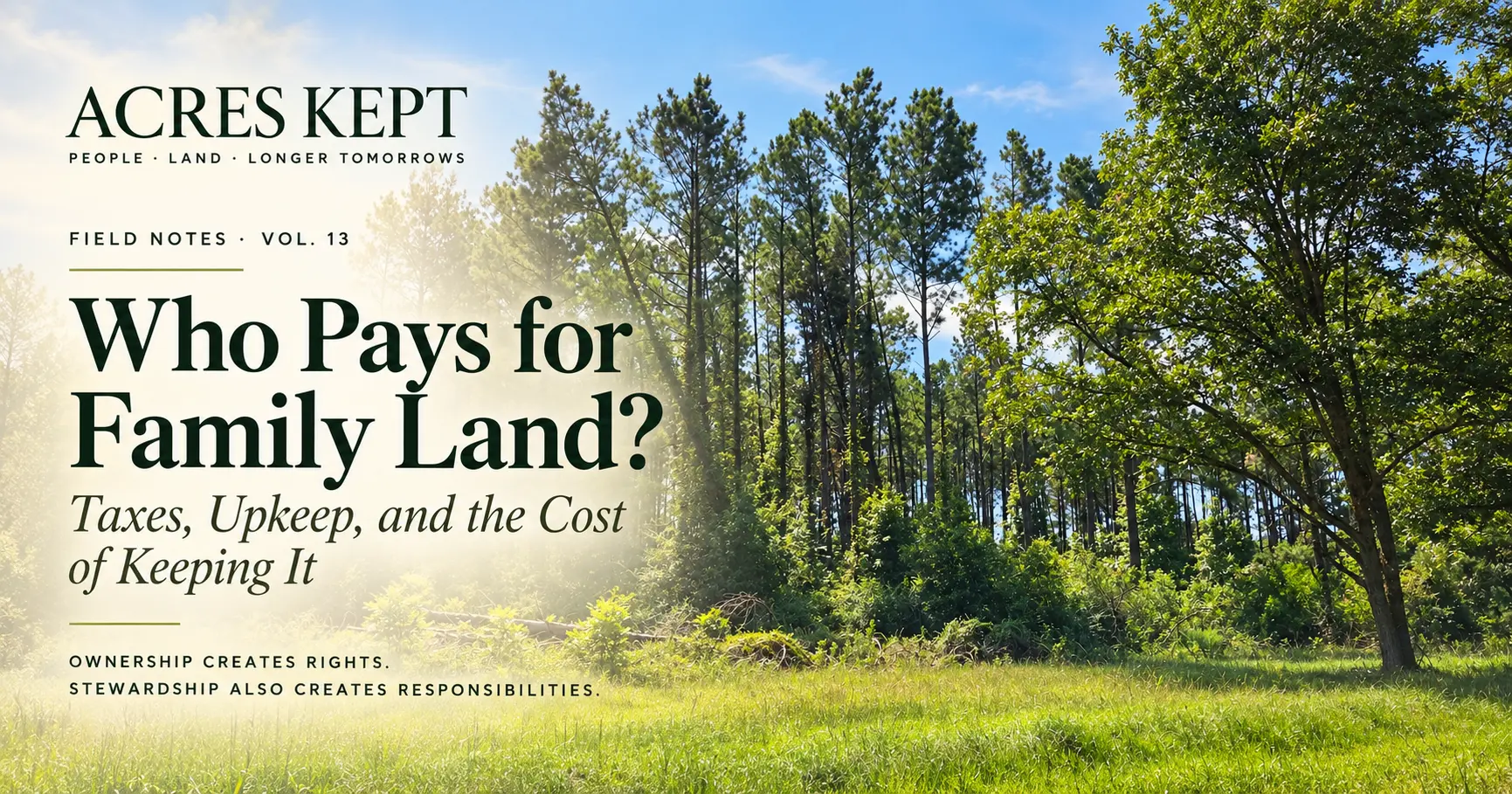
Who Pays for Family Land? Taxes, Upkeep, and the Cost of Keeping It
Letter 13 · By ACRES KEPT
Keeping family land costs money.
Property taxes still come due.
Fences break.
Roads wash out.
Trees fall.
Insurance may need to be maintained.
A well, barn, drainage system, or access road may need repair.
And sometimes the land needs investment before it can produce income at all.
Families often talk about ownership in terms of percentages.
Who owns 50 percent?
Who owns 25 percent?
Who inherited what?
But ownership creates another question that may be just as important:
Who is paying for the land while everyone owns it?
Shared ownership does not automatically create shared responsibility
One of the practical problems with jointly owned property is that legal ownership and day-to-day responsibility do not always line up.
Several people may own the land.
But one person may pay the property taxes.
Another may mow or maintain the road.
Someone else may coordinate repairs.
Other owners may contribute occasionally—or not at all.
Research published by the American Bar Association on tenancy-in-common and heirs’ property has identified this as a recurring problem. Co-owners may share legal rights to property while the obligations associated with operating and maintaining the land are not always clearly defined in practice. In some families, one or two owners end up paying a disproportionate share of property taxes, mortgage obligations, insurance, or other operating expenses.
That can work for a while.
Until the person carrying the expense decides it no longer feels fair.
Property taxes should never be treated casually
Property taxes may be one of the most basic costs of land ownership.
They are also one of the easiest responsibilities for a family to assume someone else is handling.
The Center for Heirs’ Property Preservation warns that unclear ownership can contribute to missed or late tax payments, disagreements among relatives, difficulty accessing tax relief, and in serious cases, risk of land loss through liens or tax sales.
A family may have paid taxes on the property for decades without asking:
Whose name is on the tax record?
Where is the bill mailed?
Who actually pays it?
How does that person get reimbursed?
Are there unpaid balances?
Does anyone qualify for an exemption or other tax treatment?
Those are stewardship questions.
Not simply administrative ones.
The person paying the bill may not own more of the land
This is an important point.
One family member may have paid property taxes for ten years.
That contribution matters.
But paying taxes does not automatically mean that person owns a larger percentage of the property.
Ownership rights are determined by deeds, inheritance, probate, transfers, court orders, and applicable law—not simply by who wrote the checks.
At the same time, families should not dismiss the financial burden carried by the person who has been keeping the property current.
If one owner has repeatedly paid taxes, insurance, repairs, or other necessary costs for everyone, that can become a source of resentment.
The legal treatment of those contributions varies by state and circumstance, but the family problem is easier to recognize:
Shared benefit without shared responsibility eventually creates tension.
Not every expense is the same
One reason disagreements arise is that families use the word “expense” to describe very different things.
Some costs may be necessary simply to retain the property:
property taxes,
insurance,
mortgage obligations,
basic road or access maintenance,
emergency repairs.
Other costs may be associated with improving the property:
new fencing,
a well,
drainage work,
forestry management,
soil improvements,
a barn,
a driveway,
or conservation practices.
And some costs may support a particular family member’s use of the property rather than the entire ownership group.
That distinction matters.
If one owner wants to establish cattle, should every owner pay for the fencing?
If one owner builds a hunting cabin, is that a family expense?
If erosion threatens the road everyone uses, is that different?
There is no universal answer.
But families are more likely to reach a workable answer when they first identify what kind of expense they are discussing.
Keeping land and improving land are different financial decisions
Families sometimes believe that because they want to keep property, every proposed improvement should be supported.
That is not necessarily true.
Maintaining ownership may require a minimum level of spending.
Improving the property is a separate decision.
A $2,000 repair that prevents a road from washing away is different from a $30,000 improvement designed to support a new enterprise.
Both may be worthwhile.
But they require different conversations.
Who benefits?
Who pays?
Will the investment create income?
Will one owner use the improvement more than the others?
Does everyone need to approve the work?
What happens if someone contributes more money than everyone else?
Those questions should be answered before the investment is made whenever possible.
Income should not hide the true cost of ownership
Some family properties generate revenue.
The land may be leased.
Timber may be harvested.
Hay may be sold.
Hunters may pay for access.
A farm or other enterprise may operate on the property.
Income can make shared ownership easier.
But only if the family knows where the money goes.
Rental income should not automatically be viewed as money available for distribution.
University of Minnesota Extension notes that landowners can continue to bear expenses such as property taxes, insurance, repairs, mortgage interest, and depreciation even when property is rented to someone else.
That suggests a useful order of questions:
What did the land earn?
What did the land cost?
What needs to be reserved for future expenses?
And only then:
What, if anything, should be distributed to owners?
A family land reserve can create breathing room
One practical concept families may consider is maintaining money specifically for the property.
That does not require a complicated financial system.
It means recognizing that land has recurring obligations and planning for them before the next bill arrives.
A reserve might be used for:
annual property taxes,
insurance,
routine maintenance,
emergency repairs,
professional services,
survey or title expenses,
or planned improvements.
The appropriate amount will differ by property.
But the principle is simple:
If the family intends to keep the land, the family should have some idea of what keeping it costs.
Waiting until taxes are due or an emergency repair is needed can force decisions under pressure.
Transparency matters as much as contribution
Money problems become family problems quickly when people do not know what is happening.
The person managing the land may feel:
“I am paying for everything.”
Other owners may be thinking:
“No one ever told me what was needed.”
Both can be true at the same time.
This is why recordkeeping matters.
Families do not need a corporate accounting department.
But someone should be able to answer basic questions:
What expenses were paid this year?
Who paid them?
What income did the land produce?
What is due next?
What improvements are being considered?
How much money is available?
What decisions require agreement?
Clear records make it easier to discuss fairness without relying on memory.
Ownership clarity and financial clarity belong together
The Center for Heirs’ Property Preservation has emphasized that inherited and jointly owned land often involves overlapping questions of legal ownership, property taxes, land management, and family communication.
That is why clearing title alone does not solve every stewardship problem.
A family can know exactly who owns the land and still struggle if no one knows:
who pays,
who manages,
who approves expenses,
or how income is used.
Legal clarity creates a foundation.
Financial clarity helps the family operate on top of it.
The ACRES KEPT perspective
Families often talk about land retention as though keeping the property is simply a decision.
“We are not selling.”
That decision matters.
But keeping land is also an ongoing commitment.
Someone has to pay the taxes.
Someone has to watch the property.
Someone has to manage maintenance.
Someone has to respond when something breaks.
And if the family wants the land to become more productive, someone may need to invest before the land produces a return.
The stronger question is not simply:
“Do we want to keep the land?”
It is:
“How are we going to sustain the land we say we want to keep?”
That conversation may include ownership percentages.
But it should also include expenses, responsibilities, income, reserves, and expectations.
Families do not necessarily need everyone to contribute in exactly the same way.
One person may contribute money.
Another may contribute labor.
Another may manage records or coordinate contractors.
What matters is that the arrangement is understood.
Because the cost of keeping family land should not remain invisible until the person carrying it can no longer do so.
Ownership creates rights.
Stewardship also creates responsibilities.
Sources Referenced
- American Bar Association — tenancy-in-common ownership, heirs’ property, and co-owner responsibilities for shared property expenses
- Center for Heirs’ Property Preservation — property taxes, legal clarity, land management, and heirs’ property readiness
- University of Minnesota Extension — property ownership, leasing costs, taxes, insurance, repairs, and other landowner expenses
Field Notes provides general educational information and does not constitute legal, tax, financial, accounting, estate-planning, agricultural, or real estate advice. Property-tax rules, co-owner obligations, reimbursement rights, and ownership laws vary by state and individual circumstances. Families should consult qualified legal, tax, financial, and other professional advisers regarding their specific property.