County Field Notes · August 18, 2026
Burke County, Georgia: Productive Land at the Crossroads of Agriculture, Forestry and Energy
- County Field Notes
- County: Burke County, Georgia
- State: Georgia
- Focus: Agriculture · Forestry · Energy · Family land
- 7–8 min read
- Access: Public field note + member guidance
Land, livelihood and stewardship across the ACRES KEPT region. Burke County offers a useful window into the choices facing rural landowners across the South.
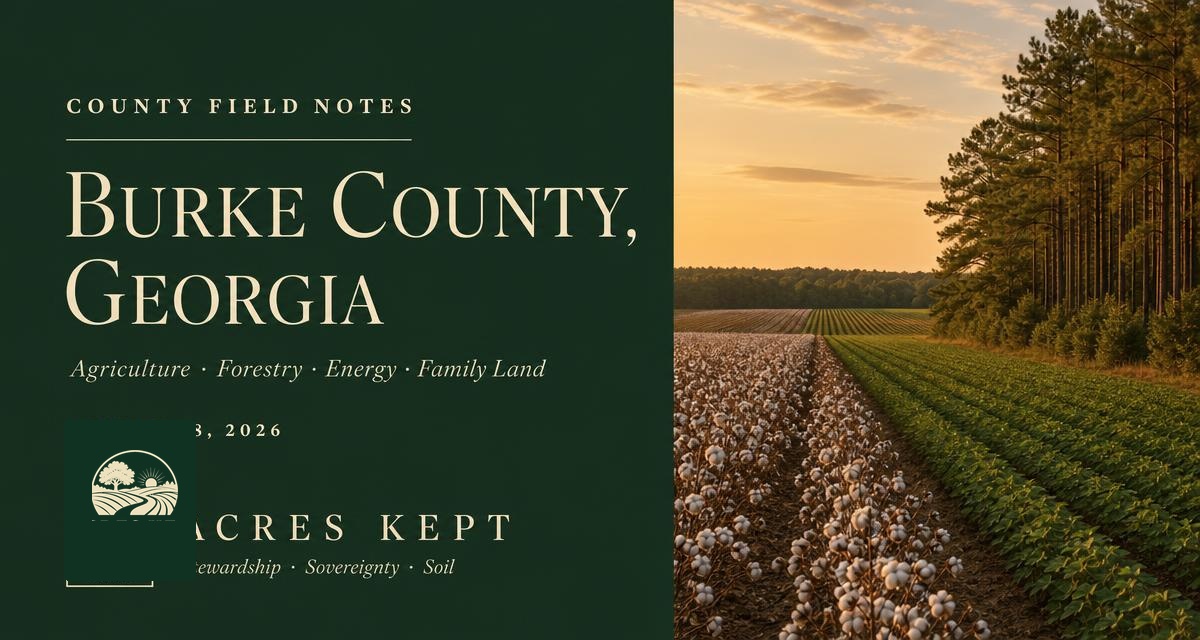
County Field Notes is an ACRES KEPT series examining the agricultural, economic and land-use conditions shaping counties across Georgia, Mississippi and Alabama. Each edition offers a county-level view of what is changing, why it may matter to landowners and families, and what responsible stewards should understand about the local landscape.
County Field Notes does not identify private land opportunities, participating landowners or properties that may be available for sale, lease or transfer. Any land-specific participation in the ACRES KEPT network remains private and subject to landowner consent.
Burke County offers a useful window into the choices facing rural landowners across the South.
Located along Georgia's eastern border and anchored by Waynesboro, Burke County encompasses more than 827 square miles. Agriculture, woodland, livestock production, family-owned land and major energy infrastructure all occupy parts of its landscape. The county is also sparsely populated, with about 30 residents per square mile.
These characteristics matter because land rarely serves only one purpose.
A tract may simultaneously be a family inheritance, a working farm, timberland, wildlife habitat and a source of future income. At the same time, new infrastructure or energy uses may create options that previous generations never had to evaluate.
For ACRES KEPT, the important question is therefore not simply, “What is land worth in Burke County?” A better question is: What should a family understand about its land before deciding what comes next?
Agriculture remains a significant part of the land story
The 2022 USDA Census of Agriculture counted 403 farms covering 214,575 acres in Burke County. Since 2017, the number of farms declined 14%, while land in farms declined 4%. At the same time, average farm size increased 11%, to 532 acres.
That combination is worth watching.
Fewer farms, a smaller overall agricultural land base and larger average operations can indicate increasing concentration of production. It does not tell us why individual farms disappeared, but it raises an important stewardship question: when agricultural land changes hands, who will be positioned to continue operating it?
Burke County farms generated approximately $142.1 million in agricultural product sales in 2022, up 20% from 2017. Crops represented 57% of sales and livestock, poultry and related products represented 43%. Production expenses were also substantial—approximately $105.9 million—demonstrating why higher gross agricultural sales should not automatically be interpreted as greater financial security for individual producers.
Cotton was the county's largest crop by acreage, with 35,883 acres, followed by peanuts at 20,421 acres and corn for grain at 19,292 acres. USDA ranked Burke County third among Georgia counties in sales of grains, oilseeds, dry beans and dry peas.
Livestock is equally important to understanding the county. Burke County reported 25,810 cattle and calves, and milk sales totaled approximately $53.8 million, ranking the county second in Georgia for that category.
Why this matters for landowners
Productive agricultural land does not generate value by acreage alone.
Soils, irrigation, road access, field configuration, drainage, proximity to other operating acreage and existing infrastructure can all influence whether land remains economically useful for agriculture.
Burke County had 42,525 irrigated acres, equal to about 20% of its land in farms.
For a family considering the future of agricultural property, questions about water rights and access, irrigation equipment, leases, fencing, field access and existing farm relationships may therefore be just as important as determining a market price.
Burke County includes both large operations and smaller family farms
Burke County agriculture is not one uniform market.
USDA reported that 34% of farms had agricultural sales below $2,500, while 25% had sales of $100,000 or more. About 23% of farms were under 50 acres, while 31% contained 500 acres or more.
That range matters.
A 30-acre inherited family property and a 1,500-acre commercial farming operation may appear in the same county agricultural statistics, but their owners face very different decisions.
Smaller or non-operating landowners may be asking:
- Should the land be leased?
- Could someone else farm it?
- Should timber be managed separately?
- Is conservation appropriate?
- Who in the family has authority to make decisions?
- What will happen when the current generation dies?
The 2022 agricultural census identified 673 producers in Burke County. Of those, 278 were age 65 or older, compared with only 64 under age 35. At the same time, USDA identified 256 new and beginning producers, and 90% of the county's farms were classified as family farms.
Those numbers point to both a challenge and an opportunity.
A substantial share of the county's producers is approaching or has already reached traditional retirement age. Land and operating control will inevitably transition. Meanwhile, beginning farmers exist who may need access to land.
Those two circumstances do not automatically connect.
Creating workable transitions may require written leases, mentoring, financing, gradual ownership arrangements or partnerships that allow landowners to retain ownership while productive use continues.
Woodland should not be treated as “unused” land
USDA recorded 66,271 acres of woodland within Burke County farms in 2022.
That figure does not represent all forestland in the county. It does, however, demonstrate how often agriculture and woodland coexist within the same ownership.
For family landowners, woodland can easily become the part of a property that receives the least attention. That can be costly.
A family should know:
- Where its forest boundaries are.
- Whether timber has been professionally inventoried.
- Whether a forest-management plan exists.
- When timber was last harvested or thinned.
- Whether roads and access points are documented.
- Whether anyone has authority to enter, hunt or harvest timber.
- Whether reforestation or prescribed-fire work is needed.
Forestland may support timber income, hunting leases, wildlife management, conservation, recreation or integration with agricultural uses. Suitability—not pressure to force every acre into production—should guide the decision.
Energy creates another layer of land-use decisions
Burke County is also home to the Alvin W. Vogtle Electric Generating Plant.
Plant Vogtle's Units 3 and 4 began commercial operation in July 2023 and April 2024, respectively, joining the facility's two existing units. Georgia Power reports more than 1,600 people now work across the four-unit facility.
Energy infrastructure therefore forms an unusually significant part of Burke County's economic and land-use environment.
And the county continues to address emerging energy uses. Burke County's Planning Department provides a current land-development code, a 2023–2028 comprehensive-plan update and specific local regulation concerning battery energy storage systems. The county also instructs property owners and developers to verify whether proposed businesses or land uses comply with zoning requirements.
Why this matters for landowners
An energy company or developer may view rural acreage very differently from a farmer, forester or family landowner. That does not make an energy proposal inherently good or bad. It makes understanding the agreement critical.
Before entering a long-term energy, utility or development arrangement, a landowner should understand:
- How many acres will be controlled?
- What uses will be prohibited?
- How long will the option and lease periods last?
- Can the agreement be assigned to another company?
- Who controls access?
- Who is responsible for taxes and improvements?
- What happens if the project is never built?
- What happens when the agreement ends?
- Who is responsible for restoring the property?
- How might the agreement affect heirs or future owners?
A high annual payment can attract attention. But a 20-, 30- or 40-year agreement can shape the family's options for an entire generation.
That is why independent legal, financial and land-use advice matters before—not after—a long-term agreement is signed.
Population trends add another dimension
Burke County's estimated population was 24,408 in 2025, a 0.8% decline from its April 2020 estimates base. About 21.7% of residents are 65 or older, and 43.8% of the county's population identifies as Black alone.
The Census Bureau reports median household income of $53,014 for 2020–2024 and a poverty rate of 24.2%.
These are not simply demographic statistics. They provide context for family land decisions.
A landowner can possess a valuable asset while having limited cash available for property taxes, surveys, legal work, forestry management or repairs. Older owners may postpone succession planning. Family members may have moved away. One sibling may want to retain land while another needs immediate income.
These circumstances can make an unsolicited cash offer especially powerful.
That is why land value and family financial capacity should not be confused. The existence of valuable land does not necessarily mean the family has the resources or preparation required to make the best decision about it.
Heirs' property deserves particular attention
ACRES KEPT does not assign a speculative number of heirs' property acres to Burke County. There is no complete public database that allows us to identify every heirs' property tract accurately.
The issue is nevertheless relevant.
Burke County has a substantial Black population, a large agricultural and woodland base, significant family-farm ownership and an aging producer population. Those factors make title clarity, estate planning and intergenerational transition especially important.
Heirs' property can result when land passes to multiple relatives without the title being properly consolidated or updated. The Georgia Heirs Property Law Center describes heirs' property as fractured ownership that can arise when property passes to multiple relatives, including through intestate succession.
Over generations, the number of owners can grow. Eventually a family may discover that:
- The deed remains in a deceased relative's name.
- Dozens of descendants have ownership interests.
- Some heirs cannot be located.
- No one clearly has authority to sign a lease.
- Financing or government-program participation becomes harder.
- Family members disagree about management or sale.
The Georgia Heirs Property Law Center provides services that include title research, probate, quiet-title actions, family meetings, estate planning and ownership-management structures. It also helps connect eligible landowners with land and timber-management programs.
For families, the important lesson is simple: Do not wait for an offer, emergency or dispute to determine who actually owns the land.
Official sources
- USDA NASS — 2022 Census of Agriculture, Burke County, Georgia profile
- U.S. Census Bureau — QuickFacts, Burke County, Georgia
- Burke County, Georgia — Planning Department
- Georgia Power — Plant Vogtle Units 1, 2, 3 & 4
- UGA Cooperative Extension — Burke County
- USDA Natural Resources Conservation Service — Georgia
- Georgia Heirs Property Law Center
Public-Use Notice: County Field Notes provides county-level educational information and does not constitute legal, financial, tax, investment, appraisal or land-management advice. The stewardship pathways discussed are possibilities, not recommendations for a particular property. Land capability, title, zoning, water access, infrastructure, financing, family goals and qualified professional advice should be considered before making land-use or ownership decisions. ACRES KEPT does not publish parcel-level opportunities, participating landowner identities, confidential ownership circumstances, private property availability or detailed acquisition intelligence through County Field Notes. Research and source verification: August 18, 2026.
Checking your access…