County Field Notes · October 27, 2026 · 7–8 min read
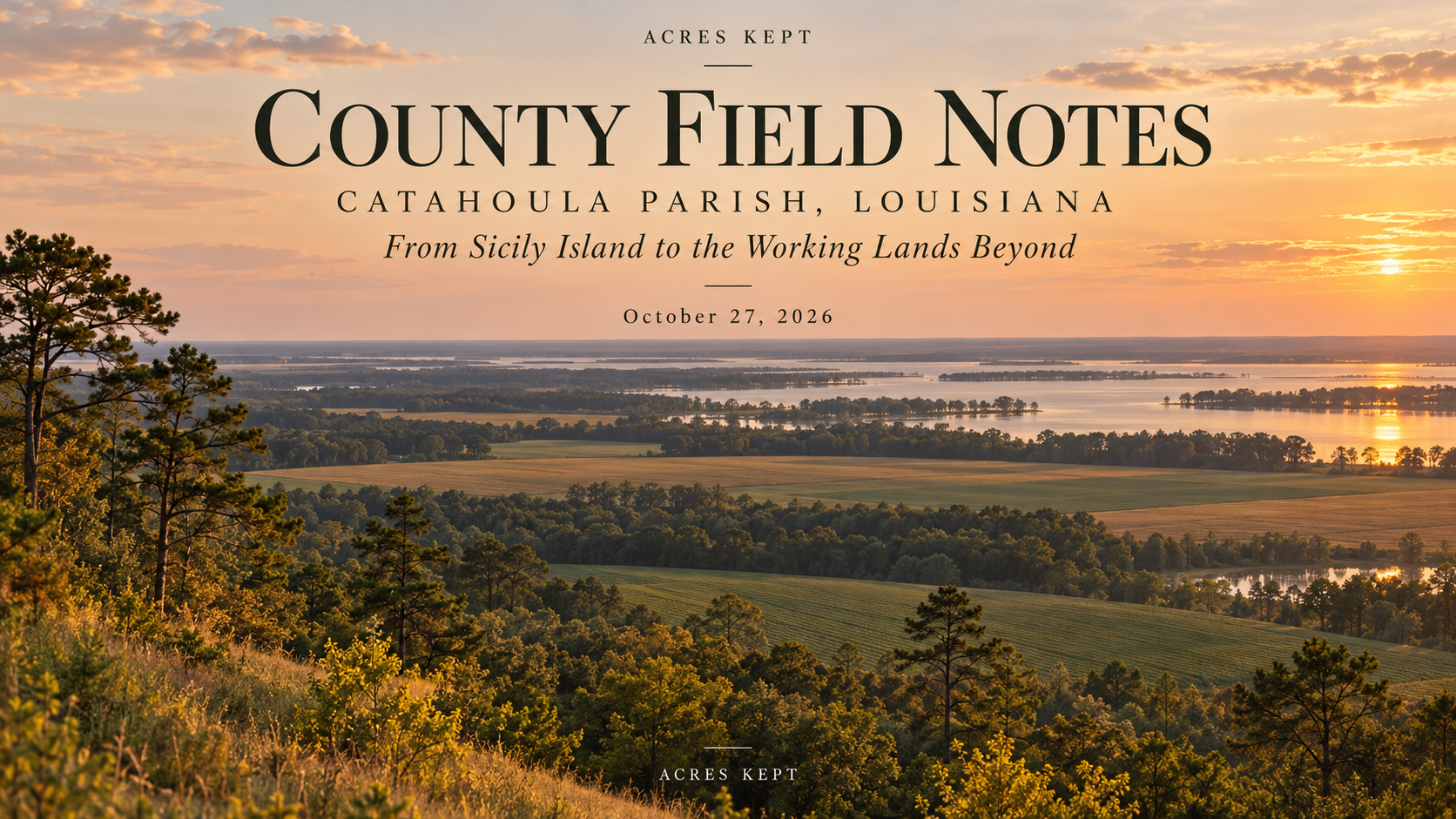
Catahoula Parish, Louisiana: From Sicily Island to the Working Lands Beyond
Land, livelihood and stewardship across the ACRES KEPT region
Sicily Island offers a window into Catahoula Parish’s working-land economy: row crops, woodland, water and multigenerational ownership in a changing rural community.
County Field Notes is an ACRES KEPT series examining the agricultural, economic and land-use conditions shaping rural counties and parishes across the South. Each edition offers a place-based view of what is changing, why it may matter to landowners and families, and what responsible stewards should understand about the local landscape.
County Field Notes does not identify private land opportunities, participating landowners or properties that may be available for sale, lease or transfer. Any land-specific participation in the ACRES KEPT network remains private and subject to landowner consent.
Sicily Island is one of the small communities that gives Catahoula Parish its character.
The village sits within a parish whose economy and landscape are deeply tied to working land. Agriculture stretches well beyond the boundaries of any one town, connecting communities through soybeans, corn, cotton, rice, timber, water, wildlife and multigenerational ownership.
Louisiana identifies Sicily Island as one of Catahoula Parish’s incorporated villages, alongside Harrisonburg, the parish seat, and Jonesville.
But the larger land story is parish-wide.
Catahoula Parish covers roughly 708 square miles and had an estimated population of 8,223 in 2025, down 7.7% from its 2020 population base. With only about 13 residents per square mile, it is a place where land occupies far more physical space than population.
That creates a central stewardship question:
What happens to productive rural land when communities become smaller, landholdings become larger and ownership moves from one generation to the next?
Agriculture Occupies a Large Share of the Parish
The 2022 USDA Census of Agriculture counted 427 farms covering 289,053 acres in Catahoula Parish.
The number of farms changed very little from 2017, declining just 1%.
But the amount of land in farms increased 38%, while average farm size increased 40%, reaching 677 acres.
That combination is striking.
It suggests that while the overall number of farms has remained relatively stable, considerably more acreage is being operated within the agricultural system—and on average, those operations have become much larger.
Twenty percent of Catahoula Parish farms contained 1,000 acres or more in 2022.
At the same time, half of all farms reported less than $2,500 in agricultural sales.
Those two realities can exist in the same parish:
large commercial operations alongside smaller family holdings, part-time farms and inherited acreage that may generate little direct farm income.
That distinction matters when talking about “farmland.”
Not every landowner is operating at commercial scale.
And not every family that owns agricultural land considers itself a farming family.
Row Crops Drive the Agricultural Economy
Catahoula Parish is unmistakably a crop-producing parish.
Approximately 97% of agricultural sales came from crops in 2022. Total agricultural product sales reached approximately $124.2 million, up 76% from 2017.
Soybeans dominated acreage, with approximately 109,445 acres planted.
Other major crops included:
- Corn for grain — 34,552 acres
- Cotton — 26,335 acres
- Rice — 3,671 acres
- Forage and hay — 3,033 acres
Sales of grains, oilseeds, dry beans and dry peas totaled approximately $103.1 million, while cotton and cottonseed accounted for another $16.2 million.
The LSU AgCenter continues to describe Catahoula as a major agricultural parish producing cotton, corn, soybeans, wheat, grain sorghum and rice. Its local programming includes crop demonstrations, fertility trials, pesticide training and producer education designed around the needs of the parish’s working farms.
Why This Matters
Large-scale row-crop agriculture depends on more than land ownership.
It depends on:
- Field size and configuration
- Drainage
- Irrigation
- Road access
- Equipment access
- Soil productivity
- Water management
- Farm operators
- Capital
- Commodity markets
Catahoula Parish had approximately 62,197 irrigated acres in 2022—about 22% of land in farms.
For a family that owns farmland but does not operate it, the value of the property may therefore depend partly on whether those agricultural systems remain intact.
Breaking a large tract into smaller pieces may affect more than ownership.
It can affect whether the acreage remains practical to farm.
Cropland Is Only Part of the Landscape
Of Catahoula Parish’s land in farms, USDA classified approximately:
- 204,800 acres as cropland
- 44,671 acres as woodland
- 13,458 acres as pastureland
- 26,124 acres in other agricultural uses
That mixed landscape matters.
A single family tract may contain productive crop acreage, woods, low areas, water, roads and acreage that serves wildlife or recreational purposes.
The LSU AgCenter notes that forestry and wildlife are important parts of the parish’s natural-resource programming, including education on forest management, sustainability, wildlife habitat and invasive species.
For family landowners, this is an important reminder:
not every acre needs to perform the same job.
Cropland may produce annual income.
Timber may operate on a much longer cycle.
Wet areas may have ecological value.
Other acreage may support hunting, wildlife, recreation or conservation.
Stewardship begins with understanding what each part of the land is suited to do.
The Economics Are Stronger—but So Are the Costs
Catahoula Parish agricultural sales increased substantially between 2017 and 2022.
But farm expenses rose almost as quickly.
USDA reported:
- Market value of products sold: $124.2 million, up 76%
- Farm production expenses: $110.6 million, up 74%
- Net cash farm income: $25.1 million, up 39%
Those numbers demonstrate why agricultural revenue should never be confused with agricultural profitability.
Landowners who lease acreage may see commodity prices and assume farm operators are enjoying strong margins.
Operators may see high land values and assume landowners have significant cash wealth.
Neither assumption is necessarily correct.
Fuel, fertilizer, seed, equipment, labor, insurance, interest and repairs all affect the economics of farming.
For family landowners, understanding those pressures can lead to more realistic conversations about rent, lease terms, improvements and long-term land use.
An Aging Producer Population Creates a Transition Question
USDA identified 757 producers in Catahoula Parish in 2022.
Of those:
- 75 were under age 35
- 367 were ages 35–64
- 315 were age 65 or older
USDA also identified 203 new and beginning producers, and 89% of farms were classified as family farms.
Those figures raise a familiar but increasingly urgent question:
Who will operate the land next?
Ownership and operation are not the same thing.
A family may want to keep the land without farming it.
A farmer may want to expand without purchasing more property.
A beginning producer may have agricultural knowledge but no access to acreage.
An older operator may be ready to slow down without wanting to sell.
Those circumstances create opportunities for responsible leasing, gradual transition and shared stewardship.
But those arrangements require preparation before retirement, illness or inheritance forces the issue.
Rural Population Decline Changes the Family-Land Equation
Catahoula Parish had 10,407 residents in 2010.
By 2020, that number had declined to 8,906.
The Census Bureau estimated just 8,223 residents in 2025, representing another 7.7% decrease from the 2020 estimates base. Approximately 23.4% of residents are age 65 or older.
The 2020–2024 American Community Survey estimated median household income at approximately $50,275. Census QuickFacts reported a poverty rate of 22.6%.
Population loss matters to land stewardship.
As younger generations leave, family property does not leave with them.
Someone still has to:
- Pay taxes
- Manage leases
- Maintain roads and boundaries
- Respond to timber or agricultural proposals
- Address storm or flood damage
- Handle succession
- Make decisions when an owner dies
A family can therefore become geographically distant from its land long before it becomes legally separated from it.
That distance makes documentation and clear decision-making increasingly important.
Heirs’ Property and “Tangled Titles” Are Especially Relevant
Louisiana has a distinctive legal system, but the underlying family-land problem is familiar.
Property may pass informally from generation to generation while legal title remains unresolved.
The Louisiana State Bar has described these situations as “tangled titles,” where multiple heirs may inherit fractional ownership interests over time. The result can be difficulty controlling property, accessing financing or disaster assistance, resolving tax issues or making major decisions.
Louisiana Appleseed has worked on inherited-property and clear-title issues for years, including education aimed at helping families understand how informal inheritance can create legal and financial vulnerability.
For Catahoula Parish families, title readiness matters because rural property can remain in a family for generations while ownership becomes increasingly complicated.
A family may believe everyone knows “whose land it is.”
The courthouse records may tell a different story.
That difference matters when the family wants to:
- Sign a farm lease
- Sell timber
- Borrow money
- Enroll in conservation programs
- Resolve taxes
- Sell land
- Transfer ownership
- Respond to an emergency
The safest time to resolve title is before a transaction makes the problem urgent.
Official sources
- USDA NASS — 2022 Census of Agriculture, Catahoula Parish, Louisiana Parish Profile
- U.S. Census Bureau — QuickFacts, Catahoula Parish, Louisiana
- LSU AgCenter — Catahoula Parish Profile
- LSU AgCenter — Catahoula Parish Extension Office
- USDA Natural Resources Conservation Service — Louisiana
- Louisiana Appleseed — Heir Property
- Louisiana State Bar Association — Louisiana’s Tangled Titles: Best Practices
- Louisiana State Bar Association — Lawyers in Libraries
- State of Louisiana — Catahoula Parish Profile
- USDA NRCS — Louisiana Open Pine Landscape Restoration initiative
County Field Notes provides county- and parish-level educational information and does not constitute legal, financial, tax, investment, appraisal or land-management advice. The stewardship pathways discussed are possibilities, not recommendations for a particular property. Land capability, title, succession status, zoning, water access, infrastructure, financing, agricultural contracts, family goals and qualified professional advice should be considered before making land-use or ownership decisions. ACRES KEPT does not publish parcel-level opportunities, participating landowner identities, confidential ownership circumstances, private property availability or detailed acquisition intelligence through County Field Notes.
Checking your access…