County Field Notes · September 22, 2026
Covington County, Mississippi: Where Poultry, Pasture and Forestland Shape the Rural Economy
- County Field Notes
- County: Covington County, Mississippi
- State: Mississippi
- Focus: Poultry · Cattle · Pasture · Forestland · Family land
- 7–8 min read
- Access: Public field note + member guidance
Land, livelihood and stewardship across the ACRES KEPT region. Covington County shows how poultry, pasture and forestland shape a rural economy — and what that means for families that own land there.
County Field Notes is an ACRES KEPT series examining the agricultural, economic and land-use conditions shaping counties across Georgia, Mississippi and Alabama. Each edition offers a county-level view of what is changing, why it may matter to landowners and families, and what responsible stewards should understand about the local landscape.
County Field Notes does not identify private land opportunities, participating landowners or properties that may be available for sale, lease or transfer. Any land-specific participation in the ACRES KEPT network remains private and subject to landowner consent.
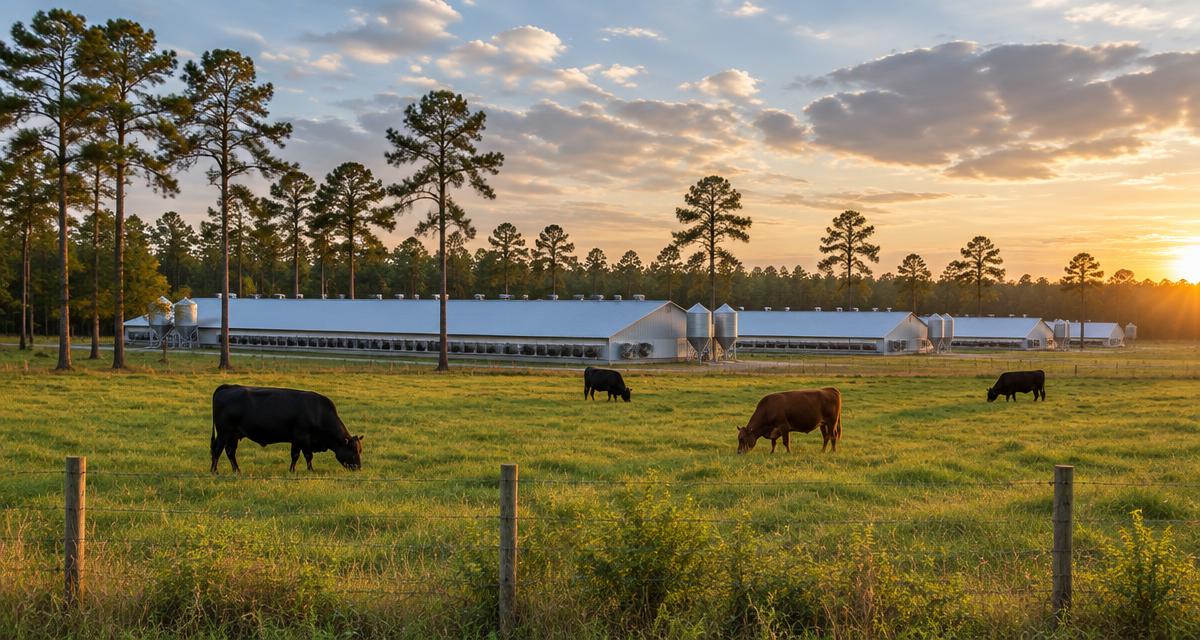
Covington County sits in south-central Mississippi, where working land is shaped by a combination of poultry production, cattle, pasture, timber and family-owned rural property.
Unlike some agricultural counties dominated by large row-crop operations, Covington County tells a different story.
Its agricultural economy is overwhelmingly tied to livestock and poultry. Its farm landscape contains substantial pasture and woodland. Its population is aging and gradually declining. And its forestry sector remains an important source of jobs and economic activity.
Those conditions create an important question for families that own land here: How can land remain productive when the people, industries and generations responsible for it are changing?
Agriculture is significant — but the production mix is different
The 2022 USDA Census of Agriculture counted 422 farms covering 71,060 acres in Covington County. Between 2017 and 2022, the number of farms declined 19%, while land in farms declined 20%. Average farm size remained relatively stable at 168 acres.
Those numbers deserve attention.
A loss of farms and agricultural acreage does not tell us exactly why particular properties left production. But it does signal that the county's working-land base is changing.
At the same time, the value of agricultural products sold increased. Covington County farms generated approximately $266 million in agricultural sales in 2022, up 5% from 2017 and ranking the county 11th among Mississippi counties in total agricultural sales.
But nearly all of those sales came from one side of agriculture. Livestock, poultry and related products accounted for 98% of Covington County agricultural sales. Crop sales represented just 2%.
That makes Covington County's land economy fundamentally different from a county where cotton, corn or soybeans dominate farm income.
Poultry is a major driver
Poultry and egg sales totaled approximately $214.5 million in 2022. USDA recorded an inventory of more than 6.6 million broilers and other meat-type chickens, along with more than 100,000 laying hens and 60,000 pullets.
Those figures show how closely Covington County's agricultural economy is tied to poultry infrastructure.
A poultry operation requires much more than a chicken house. It can depend on:
- Reliable road access
- Electricity and backup power
- Water
- Waste-management systems
- Ventilation and cooling infrastructure
- Contract relationships
- Financing
- Biosecurity
- Land available for associated agricultural uses
This matters for family landowners because specialized agricultural infrastructure can create both value and obligations.
A property containing poultry houses cannot be evaluated solely by acreage. The condition of structures, remaining useful life of equipment, contract status, environmental responsibilities and financing obligations can be just as important as the underlying land.
Cattle and pasture tell another part of the story
Covington County reported 32,943 cattle and calves at the end of 2022. Sales of cattle and calves totaled approximately $43.6 million, ranking Covington County first among Mississippi counties for cattle and calf sales in the 2022 Census of Agriculture.
Pasture is therefore an important part of the county's working landscape. USDA counted:
- 31,466 acres of pastureland
- 20,018 acres of cropland
- 16,286 acres of woodland
within Covington County farms. Forage was the county's largest crop by acreage, with approximately 9,630 acres, followed by soybeans, cotton, peanuts and corn.
Why this matters
Pasture may appear less intensive than row-crop agriculture, but productive grazing land still requires management. Fences deteriorate. Water systems require maintenance. Brush and invasive vegetation can reduce usable acreage. Stocking rates must match the land. Roads and gates matter.
A family that inherits pasture without livestock may therefore face a different question from the family that inherits cropland: Should we operate the land ourselves, lease it to someone who will, or transition it to another productive use?
Leaving pasture unmanaged is itself a land-use decision — and over time it can reduce the property's productive capacity.
Forestry is more than background landscape
Woodland is another significant part of Covington County's land story. USDA recorded 16,286 acres of woodland within farms, but that figure captures only woodland associated with agricultural operations — not all forestland across the county.
Mississippi State University Extension estimates that forestry and forest-products activity generated approximately 390 jobs, $16.4 million in income and $65 million in total economic output in Covington County in 2022. Logging, forest-support services and solid-wood products accounted for much of that activity.
That matters because woodland should not automatically be viewed as acreage waiting to be cleared or sold.
For many families, timberland can be a long-duration asset. With professional management, woodland may support:
- Periodic timber income
- Reforestation
- Wildlife habitat
- Hunting and recreational leasing
- Prescribed burning
- Conservation practices
- Long-term family ownership
Poorly managed timber, however, can also create losses. A family that does not know what timber it owns, where its boundaries are or who has authority to authorize a harvest is vulnerable to poor contracts, premature cutting or unauthorized activity.
Farm consolidation and financial pressure are worth watching
Covington County's agricultural census reveals another important signal. While the number of farms and land in farms declined substantially between 2017 and 2022, agricultural sales rose 5%. At the same time, total farm production expenses increased 17%, while net cash farm income declined 12%.
Those figures should not be interpreted as describing the financial condition of every farm. They do, however, illustrate something landowners should understand: Higher agricultural revenue does not necessarily mean stronger financial security.
Feed, fuel, fertilizer, labor, equipment, repairs, insurance and financing costs all affect the economics of operating land. This is particularly relevant in poultry and livestock production, where substantial infrastructure and operating expenses can exist alongside high gross sales.
Families evaluating whether to continue, lease or transfer an agricultural operation should therefore look beyond revenue. The more important question is: What does the land and operation produce after its obligations are understood?
A county with many family farms — and an approaching generational transition
Covington County's 422 farms included 666 producers in 2022. USDA identified:
- 56 producers under age 35
- 392 between ages 35 and 64
- 218 age 65 or older
- 226 new and beginning producers
And 98% of Covington County farms were classified as family farms.
This combination deserves attention. Many of the county's farms remain family operated, yet a substantial group of producers is already 65 or older. At the same time, the county has new and beginning producers.
That means Covington County faces both sides of a land-transition question: Who will eventually step away from operating land — and who will have an opportunity to step in?
There is no guarantee those groups will connect. A retiring landowner may have children who do not want to farm. A beginning farmer may have experience but not land. A family may want to keep property but no longer operate it.
Those circumstances create potential roles for leases, management arrangements, partnerships and gradual transitions that separate one important concept from another: A family does not have to sell land simply because it no longer wants to operate the land itself.
Population trends add urgency to succession planning
The U.S. Census Bureau estimated Covington County's 2025 population at 17,898, down 2.4% from the April 2020 estimates base and down from 19,568 residents recorded in the 2010 Census. Approximately 20.3% of residents are age 65 or older, while 34.8% of the population identifies as Black alone.
Median household income for 2020–2024 was approximately $45,051, and 20% of county residents were living below the poverty line. The county's household broadband subscription rate was approximately 71.1%.
These statistics matter to land stewardship. Population decline can mean fewer family members remain near inherited property. Older owners may manage land for decades without formalizing what happens next.
Adult children may live in Jackson, Hattiesburg, Atlanta, Houston or elsewhere while continuing to own an interest in rural Mississippi property. Land may remain local even when the family no longer does.
That separation can make routine decisions — taxes, timber, leases, maintenance, access and repairs — more difficult with each generation.
Why heirs' property matters in Mississippi
ACRES KEPT does not estimate how many acres of Covington County are heirs' property unless reliable parcel-level research supports such a conclusion. But heirs' property remains highly relevant to family land in Mississippi.
The Mississippi Center for Justice explains that heirs' property can arise when land passes informally through generations without a will or completed estate process, leaving multiple descendants with undivided interests in the same property.
Mississippi adopted the Uniform Partition of Heirs Property Act in 2020, providing additional protections in certain partition proceedings involving qualifying heirs' property.
The law is important. But legislation does not replace family preparation. A family still needs to know:
- Who owns the property
- Whether estates need to be probated
- Whether deeds reflect current ownership
- Who is paying taxes
- Whether all heirs can be located
- Who has authority to make decisions
The best time to answer those questions is before a timber sale, farm transition, tax problem, outside offer or family dispute creates urgency.
Official sources
- USDA NASS — 2022 Census of Agriculture, Covington County, Mississippi profile
- MSU Extension — Economic Contributions of Forestry and Forest Products in Covington County
- U.S. Census Bureau — QuickFacts, Covington County, Mississippi
- Mississippi Center for Justice — Heirs' Property
- Mississippi Center for Justice — Uniform Partition of Heirs Property Act
- Mississippi Center for Justice — Heirs' Property Application for Service
- Mississippi Forestry Commission — Region 3 / Service Area 37
- MSU Extension — Covington County
- USDA Natural Resources Conservation Service — Mississippi
Public-Use Notice: County Field Notes provides county-level educational information and does not constitute legal, financial, tax, investment, appraisal or land-management advice. The stewardship pathways discussed are possibilities, not recommendations for a particular property. Land capability, title, zoning, infrastructure, financing, agricultural contracts, family goals and qualified professional advice should be considered before making land-use or ownership decisions. ACRES KEPT does not publish parcel-level opportunities, participating landowner identities, confidential ownership circumstances, private property availability or detailed acquisition intelligence through County Field Notes. Research and source verification: September 12, 2026.
Checking your access…